Showing posts with label TV. Show all posts

Monday, October 3, 2011

Doctor Who: The War Games

Continuing my catch-up of highlights from the last 50 years of Doctor Who, we reach the end of the Second Doctor's era.

(Spoilers follow)


And the difference in ambition between earlier stories and "The War Games" is huge: 10 parts, richer music and camerawork, multiple time zones, a more complex story, diverse motivations... and... we finally meet the Doctor's own people...

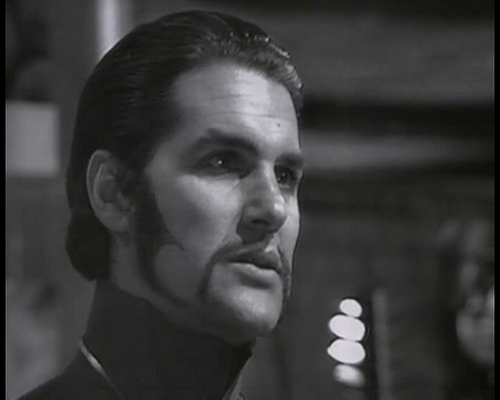
The Doctor, Jamie and Zoe discover a planet on which soldiers abducted from various times in Earth's history are being brainwashed into continuing their conflicts in simulations of those periods. The idea is to train an army to conquer the universe. The plotters are helped by a renegade Time Lord, "The War Chief", one of the Doctor's own race.

There is a revealing exchange between the Doctor and the War Chief, in which the Doctor is defensive about his reasons for leaving his home planet and rejects the War Chief's quest for power.

WAR CHIEF: You may have changed your appearance, but I know who you are.
THE DOCTOR: Oh do you?
WAR CHIEF: Your machine is a TARDIS. You're too familiar with its controls to be a stranger.
THE DOCTOR: I had every right to leave.
WAR CHIEF: Stealing a TARDIS? Oh I'm not criticising you; we are two of a kind.
THE DOCTOR: We most certainly are not!
WAR CHIEF: We were both Time Lords and we both decided to leave our race.
THE DOCTOR: I had reasons of my own.
WAR CHIEF: Just as I had.
THE DOCTOR: Your reasons are only too obvious: power!
WAR CHIEF: How much have you learnt of our plans?
THE DOCTOR: I know you've been kidnapping soldiers from the Earth from various times in its history and bringing them here to kill one another.
WAR CHIEF: But do you realise our ultimate objectives?
THE DOCTOR: No objective can justify such slaughter!
WAR CHIEF: The war games on this planet are simply a means to an end. The aliens intend to conquer the entire galaxy. A thousand inhabited worlds.
THE DOCTOR: Yes, but why choose the people of the Earth?
WAR CHIEF: They are the most suitable recruits for our armies. Man is the most vicious species of all.
THE DOCTOR: Well that simply isn't true!
WAR CHIEF: Hmm... Consider their history; for a half a million years they have been systematically killing each other. Now we can turn this savagery to some purpose. We can bring peace to the galaxy - and you can help. You see, I'm not the cold-hearted villain you suppose me to be. My motives are purely peaceful.

The climax sees the Doctor calling for help from the Time Lords via a small box, a means of communication that cropped up again earlier this year in "The Doctor's Wife". The last episode is on the Time Lord home planet (which we now know to be Gallifrey).

Having seen the Time Lords appearing as from Hell in the Tenth Doctor's final story, the Time Lords in the War Games initially appear monk-like. They seem austere, gentle, peaceful, thoughtful, serene, slightly aloof. But then we come to their punishments... They decree that the planet behind the war games plot is to be isolated forever from the rest of the universe by a permanent force field. And the leaders of the plot are removed from time, as if they never existed.

Meanwhile, the Time Lord's punishments for the Doctor's crimes (stealing the TARDIS and interfering in history) are particularly cruel. They force a regeneration on the Doctor and exile him to a single time on a single planet (Earth); something like torture for an inveterate wanderer in time and space. But they go further, and wipe Jamie's and Zoe's memories of the Doctor, apart from their first encounter with him. Just as with Donna Noble in recent series, the loss of memories of so many adventures that saw these companions develop and grow as people seems shocking. Jamie and Zoe do not know they have suffered, but a central part of their existence has been lost to them. Moreover, this action also punishes the Doctor horribly. There is no possibility of his ever being able to reminisce about old times with these dear friends.

How was it?

Not too bad. A bit long, with some (unintentionally) laughable moments, particularly the mannered acting of the Security Chief and the unrealistic fight scenes. The bad guys come across as interestingly intelligent and diverse, although subsequent television history means that Blackadder's General Melchett has made one of the protagonists less scary than he might otherwise be! Nevertheless, some interesting ideas, pursued intelligently, unfolding nicely, and without crudely spelling everything out. The Doctor's terrific fear of the Time Lords is palpable, and his attitude to them hints at a liberal critique of the powerful.

Audience Reaction 2011

I decided to show just episodes 8 to 10 to one of the 21st century companions with whom I have been erratically sharing this Doctor Who catch-up. Despite the borderline offensive stereotypes (particularly of the Mexican bandit), the historical periods were of interest. But boredom thresholds were quickly breached. The special effects, music, dialogue and pace were the familiar culprits. Nevertheless, clear improvements in these aspects over previous stories were noted. The quality of the ideas was also appreciated.

Idle Questions
  • Why did the War Chief not regenerate when shot by the security guards?
  • Aren't ground troops a slightly underpowered way of conquering planets?
  • How will the Doctor get his TARDIS back?
For an alternative view...

Next time on LW's DW catch-up...
The very next episode, the Third Doctor appears in "Spearhead from Space".


Friday, September 16, 2011

No more Torchwood, touch wood

I've been busy defending Torchwood: Miracle Day to friends over the past couple of months. Now I've seen the finale I'm rather regretting that.

I never said Miracle Day was very good; just that it was a return to the ups and downs in quality of the first two series, after the blip that was the exceptional third series Children of Earth.

To be fair, I never found compelling the concept, characters and stories of the first Torchwood series (left). I stuck with it for the first two series in the hope of the writing being able to build on the flashes of brilliance that it occasionally showed. Children of Earth worked brilliantly (no thanks to the previous two series), and made me care about Jack and Gwen.

I defended Miracle Day in response to the outpouring of critical ordure that was being heaped on it in relation to the story, the characters, the sex and the violence. I didn't think it was terrible. Just not terribly good. Much like the first two series.

The final episode, though, made me rather ashamed for having stuck with Miracle Day. There were no satisfying pay-offs. No real answers. No authentic emotion. No explanations for the numerous loose ends and idiosyncratic tangents. It was naff and pointless. And an insult to the intelligence of the viewer.

I still think over the whole series that the actors did their best with, on-the-whole, weak material. The ambition was great, and the writing and direction did have their moments; but mostly this series failed to work for me at all in terms of mystery, suspense, character, story, incidental music, you name it.

If there is another series of Torchwood, I'd watch it. I tend to like sci-fi, and I couldn't bear not knowing how Jack's and Gwen's lives continue. But I'd rather there is no more Torchwood, unless it's up to the quality of Children of Earth. This series was 10 hours of my life I'm not going to get back.


Sunday, August 21, 2011

LonWon's 2011 Five Self-Denying Ordinances for the Arts


Blinkers by Alex E. Proimos http://www.flickr.com/photos/proimos/4240744343/... which is a comically overinflated way of saying that I've decided to attempt to enhance my personal enjoyment of certain art forms by stopping doing certain things that have historically failed to enhance my enjoyment by much, or have actually diminished it.


1. No spoilers

Yes: previews in the press (especially the Radio Times), review programmes on radio (Saturday Review, Front Row), and review programmes on TV (The Review Show, The Culture Show) have all in their time served to ruin the unadulterated experience of TV, film, radio, theatre and novels. Enough. Enough. Enough.

Of course, there is still the problem of how to identify what to see, to hear, and to read. So these articles and programmes have their place. But I shall be preferring "Is it any good?" over "Why is this good (or bad)?", "What resonances did this have for me?", "How does this tap into the zeitgeist?", etc.

And Wittertainment is an exception, because I love the show in itself, and Kermode and Mayo are mostly good about spoilers. But again, the minute I decide this is a film I will see, I will skip ahead.


2. No opera or dance*

Yeah, sorry, I'm a neanderthal. But there we go. I've tried. And tried. But they do nothing for me.

* Unless strongly recommended by many people I trust, of course.


3. No horror or graphic violence*

I may be a neanderthal, but I'm also squeamish.

And inconsistent... I finally saw "Saving Private Ryan" and "Get Carter" recently, having put them
off for years because of the violence, and thought them both excellent. So see the footnote. There are always exceptions.

* Again, unless strongly recommended by many people I trust.


4. No interviews with actors, directors or writers

OK, this is more controversial. Many people's enjoyment of various art forms is strongly enhanced by behind-the-scenes insights into artists' intentions and experiences. Well, rarely for me, it seems. This'll be different for most other people, I would think.


5. No "making of" programmes

See (3).

Like spoilers and interviews, such programmes are invariably beguiling, especially about things I love or make me think. But experience has taught me that for my personal enjoyment it's best to stick with the products of creativity rather than the creative process.


Maybe I'll return to these 5 Self-Denying Ordinances for the Arts in a year's time, and realize how closed-minded they have made me. Or, like a typical bigot, I will remain smug in my self-constructed self-reinforcing tiny little world view forever.


Acknowledgements


Thursday, February 24, 2011

Reflections on The End of Lost

Finally finished watching Lost.

(+++ Spoilers below +++ obviously)

The whole six series turned out to be slightly less of a shaggy dog story than I'd always suspected.

I cried, for instance, at the revelation that the ecstatic flashsideways events were simply Jack's limbo (or Heaven's Waiting Room, or however you want to interpret it); and then felt slightly ashamed at having done so, given the blatant contrivance. Rather than series-long teasing, hinting at deep parallels and ironies, much more satisfying, I think, would have been a 10 minute Last Temptation of Christ style interlude, as Jack lay dying in the Cave of Light, in which we're not sure whether the characters' lives were rebooting.

Nonetheless, by the end, we actually got some answers: e.g. the identities of "Adam and Eve", the cause of the whispering, the source of the island's power, Richard Alpert's agelessness, the purpose of the Swan station, the appearance of dead people, the nature of the smoke monster. But even these answers are ultimately unsatisfactory. What powers does the island's Protector actually have? Why did Mother behave the way she did? How was the cave constructed? Why should the donkey wheel, healing and time dilation work like that? Why are dead people appearing? Etc., etc., etc...

And many central mysteries - the "numbers", the "rules", the origins of the island's powers, the motivations of "The Others", the "infection", to name just a few - are deliberately left as mysterious.

Some people have decried the writers for making it up as they go along. To some extent that's fair. What might have worked neatly in two series was padded out to six; some characters and storylines struck a chord, others didn't, or didn't work out; and keeping the audience guessing led to several over-elaborate detours. But one has to admire the ambition of incorporating so many potentially profound themes within a mainstream show, whilst continuing to rack up the tension.

Part of the writers' skill in sustaining audience interest lay in selectively dripping answers while also striking out in new directions, without appearing to do so. The writers were somewhat protected from egregious narrative incoherence by their creation itself: a world in which all certainties are constantly undermined by the characters' propensities for deception and shifting motivations, and by hallucinations, ghosts and bodily impersonation. They were also aided in no small part by what ranks among the most effective use of music I've ever come across.

It's an incredible skill to keep the audience teetering on the edge, trying to avoid burning curiosity spill over into frustration. And leaving loose ends is not in itself a bad thing. Part of the fun of this show has been the wild speculation it permits. Moreover there's a justification for not explaining too much, in that one of the key themes of Lost was the tension between faith and science in grappling with a world full of events that might or might not be explicable by as-yet-unknown forces. It's not the forces themselves that were the point, but the characters' struggles to make sense of these events.

But, ultimately, stories don't add up to much more than something told in a beautiful way unless most mysteries and motivations are seen to resolve to a very small number of irreducible givens that one has to accept for the sake of the narrative.

The writers of Lost chose not to take that path. And that's why I say it was a shaggy dog story.

Thursday, December 23, 2010

Doctor Who: The Mind Robber

The Doctor moves the Tardis outside ordinary time and space to avoid a lava flow (which looks unintentionally rather like an excess of soap bubbles). They land in a white void.

While the Doctor goes to another room in the Tardis to begin repairs, Jamie & Zoe see images of their homes on the viewscreen. They are lured outside the Tardis, which dramatically explodes. There then follows a series of surreal encounters with an array of characters from literature including Gulliver, the Medusa, a unicorn, Rapunzel, and some life-sized toy soldiers.


How was it?

There is more mystery in this story than the previous ones in this catch-up, and the nature of this particular plot means the cruddy sets and effects are not the drawback they have been previously. However it is rather off-putting that the expanse of nothingness looks pretty much like an empty television studio; and the supposedly scary white robots look like cardboard teletubbies. Nevertheless, the premise is ingenious, and there is lots of nicely judged humour to keep things going.


Audience reaction 2010

After the last story, I decided not to inflict this one on my 21st century companions. I suspect their reaction would have been impatience with the whimsy, sardonic comments on Zoe's sparkly catsuit, and a more emotionally and intellectually engaging plot. But I think they would not have complained about the music, dialogue, acting or sets as they did previously.


Idle questions
  • How did the inhabitants of this realm get there?
  • Was the destruction of the Tardis fictional?
  • Victoria is gone, replaced by Zoe. How does the Doctor choose his companions? Are there any consequences to plucking companions out of history?
  • We saw another room in the Tardis in this story. We now know that it has many rooms. How are they created?

For an alternative view...

Next time on LW's DW catch-up...
The Second Doctor's final story: The War Games.

Friday, November 19, 2010

Doctor Who: The Tomb of the Cybermen

The Doctor, Jamie (yay, I remember him from some random episode I must have caught once) and Victoria (I don't) land on the planet Telos, and join an archaeological expedition to the 500 year old tomb of the Cybermen. It turns out that a couple of the expedition are interested in more than just history...

The pace has picked up considerably in the three years since "The Aztecs". Although the story is still fairly slight, with plenty of plot-holes, the incidental music is not quite so jarring; the direction more ambitious and polished; and the dialogue and acting are not quite so theatrical. The futuristic elements combined with the theme of exploring history create more of a sense of mystery than the Aztecs, despite the still laughable sets and props.

The Second Doctor is more playful since his regeneration, but still often seems to know more than he is letting on. He is always very manipulative in the way he assists the expedition. In a wistful moment, consoling Victoria at the recent death of her father, the Doctor says that his memories of his family are still alive when he wants them to be. He says he is 450 years old.

Audience reaction 2010

One youngster accompanied this viewing - probably better to say "endured"! - but she enjoyed making sardonic comments on the dated production values. In particular we both found the strong-and-loyal-but-dumb black manservant rather racist by 21st century standards, and the blatant sexism rather less than futuristic.

The subject of companions loomed large, with Susan, Barbara and Ian gone, replaced with Jamie and Victoria. My own companion noted how refreshing it was to have companions from different centuries (Jamie the 18th century, Victoria the 19th century) and locations (e.g. Jamie being from Scotland) rather than from 20th/21st London, as she noted seems to have become the norm. She was astounded when I let slip that companions have come from other planets too...

Watching The Sarah Jane Adventures recently, we noted the lovely reference to Barbara and Ian, that they had married each other, become Cambridge professors, and have not aged since the 1960s. This kind of reference really enhances our enjoyment of both old and new episodes!

Although not the least bit scary, one aspect of this episode that my companion noticed was the similarity between the scene here in which the members of the expedition try to escape from the Cybermen and a scene from the modern era which takes place with the Cybermen in Torchwood Tower. "And that was scary!"

Next up in this Doctor Who education enterprise are two more stories from the Second Doctor era. I suspect that the youngsters might prefer just selected moments rather than sitting through hours of this.

Idle questions
  • Presumably the Doctor assisted the expedition out of curiosity and a concern to assess the threat posed by the sleeping Cybermen. And presumably it was for compassionate reasons that he returned the Cybermen to their slumber rather than destroying them. Did he not worry though that the security he put in place would be too limited to prevent further archaeological expeditions? Is he somehow relying on the TARDIS to take him to points in the universe at which his assistance is needed?
For an alternative view...
  • John Bensalhia at Shadowlocked has a sometimes hilarious take on this story.
  • A fair review also is available at Androzani.com

Wednesday, November 3, 2010

Doctor Who: The Aztecs

The TARDIS arrives in 15th Century Mexico, and gets trapped in a tomb. Barbara is mistaken for a reincarnation of the high priest Yetaxa. She attempts to end the Aztec practice of human sacrifice, while Ian and the Doctor try to find a way back to the Tardis.

That this second post in the series of reports on my education in the Doctor Who classics is so tardy is less to do with laziness or deadlines, than because of sudden cold feet about the whole enterprise.

In short, The Aztecs is some fans' favourite of the early stories, and yet I almost entirely failed to see its attractions.

In part, of course, this might be a consequence of familiarity with the modern era: The painted backdrops, papier-mâché stones, crude incidental music, antiquated camerawork, lack of special effects, and so on are hurdles for the suspension of disbelief by modern audiences. It is not just the technical aspects: The stagey direction, hammy acting, wordy yet unsubtle dialogue, simplistic story, and laughable cliff-hangers are major hurdles too.

Is it fair to judge 1960s television production values by the standards of 2010? Probably not, but it is hard to set aside modern expectations. I did my best by treating it as a televised play, but still found the plot uninteresting.

There is one exchange that raises interesting questions. The Doctor attempts to dissuade Barbara from stopping the Aztec practice of human sacrifice by saying "But you can’t re-write history! Not one line!" Is it impossible for time-travellers to change history? Or is it that they shouldn't? Aren't they changing it by being there?

Audience reaction 2010

The youngsters who are part of my Doctor Who education had endured all the episodes of An Unearthly Child, but could only cope with one-and-half episodes of The Aztecs. These youngsters do not have gnat-sized attention spans and are far from bored by history: They found on the DVD the 1970 Blue Peter account of Cortez and Montezuma and lapped it up, asking many questions and wanting more. But they were unable to engage in the drama.

The problem now is that it will be difficult to persuade them back to this Doctor Who education until the quality of the story makes up for the production values.

Idle questions
  • Why can't you change history?
For an alternative view...

Friday, September 3, 2010

Doctor Who: An Unearthly Child

Beginning a catch-up of highly rated Doctor Who stories, guided particularly by Alex Wilcock's recommendataions. [1][2][3]

In "An Unearthly Child" we're introduced to a mysterious old man known only as "The Doctor" who has a ship called a TARDIS that travels in time and space and a grandaughter called Susan. He is rather haughty and cranky but clever. She is enthusiastic and kind.

The story, such as it is, involves two of Susan's teachers Barbara and Ian following her home and discovering the TARDIS. The Doctor reacts to this by kidnapping the teachers and taking them to the Stone Age. After getting involved in the power struggles of the local cavemen over the creation of fire, The Doctor, Susan, Barbara and Ian escape in the TARDIS.

Audience reaction 2010:Two youngsters brought up on the 9th, 10th and 11th Doctors found the slowness, laboured incidental music, pompous speeches, and low-tech effects alternately dull and hilarious. And it has to be said: television drama and production values have come a long way! But the atmospheric theme tune, the alienness of The Doctor, and the idea of the TARDIS still manage to create a sense of wonder.

Idle questions
  • With her intelligence and the power of the TARDIS, why did Susan so want to be a school pupil on earth in the 1960s?
  • How much control does The Doctor actually have over where and when the TARDIS ends up?

Thursday, October 29, 2009

Why is Any Questions better than Question Time?

I'm sure this is an old, old debate. And some people might reject the premise, pointing to a greater audience for the BBC1 television programme Question Time than the BBC Radio 4 programme Any Questions. Question Time (hereafter "QT" to minimise confusion between the two programmes) also seems to me to have a greater sense of a national political theatre about it, more of a political "event": QT is often mentioned in the full range of news media, whereas Any Questions is only rarely mentioned.

But I enjoy Any Questions much more: the discussions seem to be more interesting, deeper, more reflective than QT. Perhaps my preference is not widely shared, but I've been thinking a lot recently about why Any Questions ends up more satisfying to me, and decided it was time to write some of these possibilities down.

1. The panel members
I've no idea if there's any difference at all between the kinds of people invited on QT and those invited on any Any Questions. I haven't noticed a big difference. It seems unlikely, although QT has a reputation for some "stunt" invitations, such as soap stars and other celebrities, so perhaps there's a slightly narrower background for panel members on Any Questions.

2. The number of panel members
This might seem like a trivial thing, but I'm sure it's not. I can't remember exactly when QT moved from a panel of 4 to a panel of 5, but I remember thinking at the time that this would dilute the contributions of the members, make it harder for members to build an argument and comment on others' arguments, make it harder to chair, make it harder for the audience to follow arguments and distinguish the views. All in all, it would move the dynamics away from that of a panel towards that of 5 people being asked a succession of questions. On the positive side, I was hoping for a wider range of views and space for panel members from outside the usual political circles. My current view is that these expectations - both positive and negative - have been borne out.

3. The questions
It's only recently that I've wondered how different the questions are between the two programmes. The questions for both programmes come from the audience, and are presumably selected by the producers on the basis of popularity, topicality and the likelihood of a good discussion. My perception has been in recent years that QT questions have been tended to be more superficial; more focused on personality, trivia, gossip and petty politics and less focused on the political principles underlying decisions to be made; more provocative, but in a rhetoric-provoking rather than thought-provoking way.

4. The cameras
It's possible the sense of being looked at by millions rather than just hundreds puts people on the spot. The bright lights, the challenge of controlling one's facial expressions and mannerisms at the same time as thinking about what one is saying, the certainty that any slip will be instantly taken up and used for years by newspapers, television and YouTube... Many experienced speakers have appeared to turn into startled rabbits on QT. Conversely, some panel members seem to become more hectoring than usual.

5. The chair
This is often cited by friends as the biggest reason for why Any Questions is superior. David Dimbleby on QT, they say, is alternately bland or rude, interrupting perfectly reasonable responses to put irritating and unexpected side questions or to challenge the speaker with quotes. But I'm not sure than Jonathan Dimbleby on Any Questions is all that different. Jonathan is probably slightly more considered in how he puts his side questions, and but on the whole they detract from the discussion in much the same way. To be fair, both presenters are also often effective in cutting through waffle, or in keeping the discussion on track. I don't think they do a terrible job on the while. On Any Questions, when Jonathan Dimbleby is away, Eddie Mair and the late Nick Clarke have been better. And before David Dimbleby on QT, Peter Sissons was blander, and Robin Day was slightly sparkier with more charm. But I'm not sure the chair makes as big a difference as sometimes claimed.

6. The audiences
There have been some truly terrible audiences on QT, booing or shouting endlessly, intimidating panel members. There have been a few bad ones on Any Questions, but perhaps not quite so many, and typically much more restrained. Audience contributions on Any Questions generally seem calmer, more rational. Is this because a radio programme attracts a more cerebral audience than its more glamorous counterpart on television? Or is it another example of the effect of cameras mentioned above?

Have I missed any other possibilities? Am I being fair? I've not backed up any of the assertions here with evidence, so this is all quite weak stuff. It's all perception. Has anyone carried out empirical research into differences between the discussions on these programmes?

Update 1 Nov 2009

Oh how could I forget this one...!

7. The medium
For me, neither programme seems to need 100% of my attention. I can't just sit and listen to Any Questions, or I'll get restless. Listening to it while washing up, walking or driving is perfect. And without the distractions of what the speakers look like, I'm free to focus on the arguments, the rhetorical devices, and what they're not saying.

Meanwhile, watching QT while washing up, walking or driving are not options. However, maybe sometime I should try listening to QT while engaged in these activities, to see how the experience compares with Any Questions, and whether the pictures are adding or detracting. So occupy the excess brain-power that isn't needed in watching the programme, I've taken to Twitter or a couple of the live web chats. Unfortunately I've found that formulating intelligible sentences while continuing to watch and also trying to work out what I think of what others are saying on the internet is actually slightly more than I can cope with in order to completely follow everything that is being said on the programme. And so I think this split attention is perhaps reducing rather than enhancing what I think of the programme. However, my enjoyment of watching is definitely enhanced by these chats. So, slightly perversely, I end up thinking less of the programme, but enjoying it more.

Wednesday, July 8, 2009

And so Battlestar Galactica is over

And so Battlestar Galactica is over.

I'm left feeling meditative. About the events of the last few episodes. About how all the details of the plot hang together. About the characters, their bittersweet lives and awakenings. And most of all about the many desperate journeys: the mythic flight from Kobol to Caprica, Earth and the other colonies; the doomed story of the Pegasus; the tragic peace-keeping mission of Earth's Final Five; the fraught escape of the ramshackle fleet from the 12 colonies to Kobol, to New Caprica, to Earth, and to New Earth; the inexorable journey of Cylons from mechanoid to Centurion to god-fearing sentient; and the long journey of “humans” from Hera to us.

A most unusual sci-fi experience. Not the huge emphasis on technology, strange new worlds, aliens and space battles that one normally expects. These elements are there, for sure, just enough to pique curiosity, but not enough to detract from the subtle meditations on themes such as identity, mortality, politics, religion and destiny. It is a truly amazing achievement to have succeeded in incorporating these themes in an entertaining, action-packed TV show for a mainstream audience.

It's entirely possible that some subtleties are entirely in the mind of the viewer rather than in the intentions of the creators of BSG. But that's irrelevant. BSG was made in such a way that it renders such meditations quite normal.

I'm left with many questions. And that's also as it should be. Perhaps some will be answered by my thinking harder, or by internet forums. Perhaps others might be answered by any new series, although there is a sense of completeness to BSG that leaves me wanting to avoid more complications. But the show's aesthetic fits with there being mysteries that might never be resolved.

And these questions keep me there, in that universe, where Adama holds it all together seemingly by sheer will-power; where both Cavil and Starbuck battle inner demons to self-destruction; where Baltar cannot help himself; where machines console themselves by projecting imaginative realms; where virtual beings tweak history; and where everyone is on a journey they don't understand.