Showing posts with label Doctor Who. Show all posts

Monday, October 3, 2011

Doctor Who: The War Games

Continuing my catch-up of highlights from the last 50 years of Doctor Who, we reach the end of the Second Doctor's era.

(Spoilers follow)


And the difference in ambition between earlier stories and "The War Games" is huge: 10 parts, richer music and camerawork, multiple time zones, a more complex story, diverse motivations... and... we finally meet the Doctor's own people...

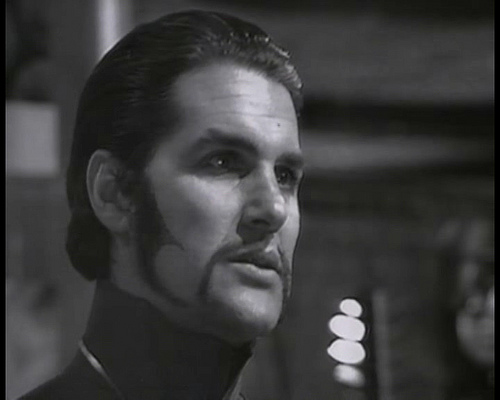
The Doctor, Jamie and Zoe discover a planet on which soldiers abducted from various times in Earth's history are being brainwashed into continuing their conflicts in simulations of those periods. The idea is to train an army to conquer the universe. The plotters are helped by a renegade Time Lord, "The War Chief", one of the Doctor's own race.

There is a revealing exchange between the Doctor and the War Chief, in which the Doctor is defensive about his reasons for leaving his home planet and rejects the War Chief's quest for power.

WAR CHIEF: You may have changed your appearance, but I know who you are.
THE DOCTOR: Oh do you?
WAR CHIEF: Your machine is a TARDIS. You're too familiar with its controls to be a stranger.
THE DOCTOR: I had every right to leave.
WAR CHIEF: Stealing a TARDIS? Oh I'm not criticising you; we are two of a kind.
THE DOCTOR: We most certainly are not!
WAR CHIEF: We were both Time Lords and we both decided to leave our race.
THE DOCTOR: I had reasons of my own.
WAR CHIEF: Just as I had.
THE DOCTOR: Your reasons are only too obvious: power!
WAR CHIEF: How much have you learnt of our plans?
THE DOCTOR: I know you've been kidnapping soldiers from the Earth from various times in its history and bringing them here to kill one another.
WAR CHIEF: But do you realise our ultimate objectives?
THE DOCTOR: No objective can justify such slaughter!
WAR CHIEF: The war games on this planet are simply a means to an end. The aliens intend to conquer the entire galaxy. A thousand inhabited worlds.
THE DOCTOR: Yes, but why choose the people of the Earth?
WAR CHIEF: They are the most suitable recruits for our armies. Man is the most vicious species of all.
THE DOCTOR: Well that simply isn't true!
WAR CHIEF: Hmm... Consider their history; for a half a million years they have been systematically killing each other. Now we can turn this savagery to some purpose. We can bring peace to the galaxy - and you can help. You see, I'm not the cold-hearted villain you suppose me to be. My motives are purely peaceful.

The climax sees the Doctor calling for help from the Time Lords via a small box, a means of communication that cropped up again earlier this year in "The Doctor's Wife". The last episode is on the Time Lord home planet (which we now know to be Gallifrey).

Having seen the Time Lords appearing as from Hell in the Tenth Doctor's final story, the Time Lords in the War Games initially appear monk-like. They seem austere, gentle, peaceful, thoughtful, serene, slightly aloof. But then we come to their punishments... They decree that the planet behind the war games plot is to be isolated forever from the rest of the universe by a permanent force field. And the leaders of the plot are removed from time, as if they never existed.

Meanwhile, the Time Lord's punishments for the Doctor's crimes (stealing the TARDIS and interfering in history) are particularly cruel. They force a regeneration on the Doctor and exile him to a single time on a single planet (Earth); something like torture for an inveterate wanderer in time and space. But they go further, and wipe Jamie's and Zoe's memories of the Doctor, apart from their first encounter with him. Just as with Donna Noble in recent series, the loss of memories of so many adventures that saw these companions develop and grow as people seems shocking. Jamie and Zoe do not know they have suffered, but a central part of their existence has been lost to them. Moreover, this action also punishes the Doctor horribly. There is no possibility of his ever being able to reminisce about old times with these dear friends.

How was it?

Not too bad. A bit long, with some (unintentionally) laughable moments, particularly the mannered acting of the Security Chief and the unrealistic fight scenes. The bad guys come across as interestingly intelligent and diverse, although subsequent television history means that Blackadder's General Melchett has made one of the protagonists less scary than he might otherwise be! Nevertheless, some interesting ideas, pursued intelligently, unfolding nicely, and without crudely spelling everything out. The Doctor's terrific fear of the Time Lords is palpable, and his attitude to them hints at a liberal critique of the powerful.

Audience Reaction 2011

I decided to show just episodes 8 to 10 to one of the 21st century companions with whom I have been erratically sharing this Doctor Who catch-up. Despite the borderline offensive stereotypes (particularly of the Mexican bandit), the historical periods were of interest. But boredom thresholds were quickly breached. The special effects, music, dialogue and pace were the familiar culprits. Nevertheless, clear improvements in these aspects over previous stories were noted. The quality of the ideas was also appreciated.

Idle Questions
  • Why did the War Chief not regenerate when shot by the security guards?
  • Aren't ground troops a slightly underpowered way of conquering planets?
  • How will the Doctor get his TARDIS back?
For an alternative view...

Next time on LW's DW catch-up...
The very next episode, the Third Doctor appears in "Spearhead from Space".


Thursday, December 23, 2010

Doctor Who: The Mind Robber

The Doctor moves the Tardis outside ordinary time and space to avoid a lava flow (which looks unintentionally rather like an excess of soap bubbles). They land in a white void.

While the Doctor goes to another room in the Tardis to begin repairs, Jamie & Zoe see images of their homes on the viewscreen. They are lured outside the Tardis, which dramatically explodes. There then follows a series of surreal encounters with an array of characters from literature including Gulliver, the Medusa, a unicorn, Rapunzel, and some life-sized toy soldiers.


How was it?

There is more mystery in this story than the previous ones in this catch-up, and the nature of this particular plot means the cruddy sets and effects are not the drawback they have been previously. However it is rather off-putting that the expanse of nothingness looks pretty much like an empty television studio; and the supposedly scary white robots look like cardboard teletubbies. Nevertheless, the premise is ingenious, and there is lots of nicely judged humour to keep things going.


Audience reaction 2010

After the last story, I decided not to inflict this one on my 21st century companions. I suspect their reaction would have been impatience with the whimsy, sardonic comments on Zoe's sparkly catsuit, and a more emotionally and intellectually engaging plot. But I think they would not have complained about the music, dialogue, acting or sets as they did previously.


Idle questions
  • How did the inhabitants of this realm get there?
  • Was the destruction of the Tardis fictional?
  • Victoria is gone, replaced by Zoe. How does the Doctor choose his companions? Are there any consequences to plucking companions out of history?
  • We saw another room in the Tardis in this story. We now know that it has many rooms. How are they created?

For an alternative view...

Next time on LW's DW catch-up...
The Second Doctor's final story: The War Games.

Friday, November 19, 2010

Doctor Who: The Tomb of the Cybermen

The Doctor, Jamie (yay, I remember him from some random episode I must have caught once) and Victoria (I don't) land on the planet Telos, and join an archaeological expedition to the 500 year old tomb of the Cybermen. It turns out that a couple of the expedition are interested in more than just history...

The pace has picked up considerably in the three years since "The Aztecs". Although the story is still fairly slight, with plenty of plot-holes, the incidental music is not quite so jarring; the direction more ambitious and polished; and the dialogue and acting are not quite so theatrical. The futuristic elements combined with the theme of exploring history create more of a sense of mystery than the Aztecs, despite the still laughable sets and props.

The Second Doctor is more playful since his regeneration, but still often seems to know more than he is letting on. He is always very manipulative in the way he assists the expedition. In a wistful moment, consoling Victoria at the recent death of her father, the Doctor says that his memories of his family are still alive when he wants them to be. He says he is 450 years old.

Audience reaction 2010

One youngster accompanied this viewing - probably better to say "endured"! - but she enjoyed making sardonic comments on the dated production values. In particular we both found the strong-and-loyal-but-dumb black manservant rather racist by 21st century standards, and the blatant sexism rather less than futuristic.

The subject of companions loomed large, with Susan, Barbara and Ian gone, replaced with Jamie and Victoria. My own companion noted how refreshing it was to have companions from different centuries (Jamie the 18th century, Victoria the 19th century) and locations (e.g. Jamie being from Scotland) rather than from 20th/21st London, as she noted seems to have become the norm. She was astounded when I let slip that companions have come from other planets too...

Watching The Sarah Jane Adventures recently, we noted the lovely reference to Barbara and Ian, that they had married each other, become Cambridge professors, and have not aged since the 1960s. This kind of reference really enhances our enjoyment of both old and new episodes!

Although not the least bit scary, one aspect of this episode that my companion noticed was the similarity between the scene here in which the members of the expedition try to escape from the Cybermen and a scene from the modern era which takes place with the Cybermen in Torchwood Tower. "And that was scary!"

Next up in this Doctor Who education enterprise are two more stories from the Second Doctor era. I suspect that the youngsters might prefer just selected moments rather than sitting through hours of this.

Idle questions
  • Presumably the Doctor assisted the expedition out of curiosity and a concern to assess the threat posed by the sleeping Cybermen. And presumably it was for compassionate reasons that he returned the Cybermen to their slumber rather than destroying them. Did he not worry though that the security he put in place would be too limited to prevent further archaeological expeditions? Is he somehow relying on the TARDIS to take him to points in the universe at which his assistance is needed?
For an alternative view...
  • John Bensalhia at Shadowlocked has a sometimes hilarious take on this story.
  • A fair review also is available at Androzani.com

Wednesday, November 3, 2010

Doctor Who: The Aztecs

The TARDIS arrives in 15th Century Mexico, and gets trapped in a tomb. Barbara is mistaken for a reincarnation of the high priest Yetaxa. She attempts to end the Aztec practice of human sacrifice, while Ian and the Doctor try to find a way back to the Tardis.

That this second post in the series of reports on my education in the Doctor Who classics is so tardy is less to do with laziness or deadlines, than because of sudden cold feet about the whole enterprise.

In short, The Aztecs is some fans' favourite of the early stories, and yet I almost entirely failed to see its attractions.

In part, of course, this might be a consequence of familiarity with the modern era: The painted backdrops, papier-mâché stones, crude incidental music, antiquated camerawork, lack of special effects, and so on are hurdles for the suspension of disbelief by modern audiences. It is not just the technical aspects: The stagey direction, hammy acting, wordy yet unsubtle dialogue, simplistic story, and laughable cliff-hangers are major hurdles too.

Is it fair to judge 1960s television production values by the standards of 2010? Probably not, but it is hard to set aside modern expectations. I did my best by treating it as a televised play, but still found the plot uninteresting.

There is one exchange that raises interesting questions. The Doctor attempts to dissuade Barbara from stopping the Aztec practice of human sacrifice by saying "But you can’t re-write history! Not one line!" Is it impossible for time-travellers to change history? Or is it that they shouldn't? Aren't they changing it by being there?

Audience reaction 2010

The youngsters who are part of my Doctor Who education had endured all the episodes of An Unearthly Child, but could only cope with one-and-half episodes of The Aztecs. These youngsters do not have gnat-sized attention spans and are far from bored by history: They found on the DVD the 1970 Blue Peter account of Cortez and Montezuma and lapped it up, asking many questions and wanting more. But they were unable to engage in the drama.

The problem now is that it will be difficult to persuade them back to this Doctor Who education until the quality of the story makes up for the production values.

Idle questions
  • Why can't you change history?
For an alternative view...

Friday, September 3, 2010

Doctor Who: An Unearthly Child

Beginning a catch-up of highly rated Doctor Who stories, guided particularly by Alex Wilcock's recommendataions. [1][2][3]

In "An Unearthly Child" we're introduced to a mysterious old man known only as "The Doctor" who has a ship called a TARDIS that travels in time and space and a grandaughter called Susan. He is rather haughty and cranky but clever. She is enthusiastic and kind.

The story, such as it is, involves two of Susan's teachers Barbara and Ian following her home and discovering the TARDIS. The Doctor reacts to this by kidnapping the teachers and taking them to the Stone Age. After getting involved in the power struggles of the local cavemen over the creation of fire, The Doctor, Susan, Barbara and Ian escape in the TARDIS.

Audience reaction 2010:Two youngsters brought up on the 9th, 10th and 11th Doctors found the slowness, laboured incidental music, pompous speeches, and low-tech effects alternately dull and hilarious. And it has to be said: television drama and production values have come a long way! But the atmospheric theme tune, the alienness of The Doctor, and the idea of the TARDIS still manage to create a sense of wonder.

Idle questions
  • With her intelligence and the power of the TARDIS, why did Susan so want to be a school pupil on earth in the 1960s?
  • How much control does The Doctor actually have over where and when the TARDIS ends up?